
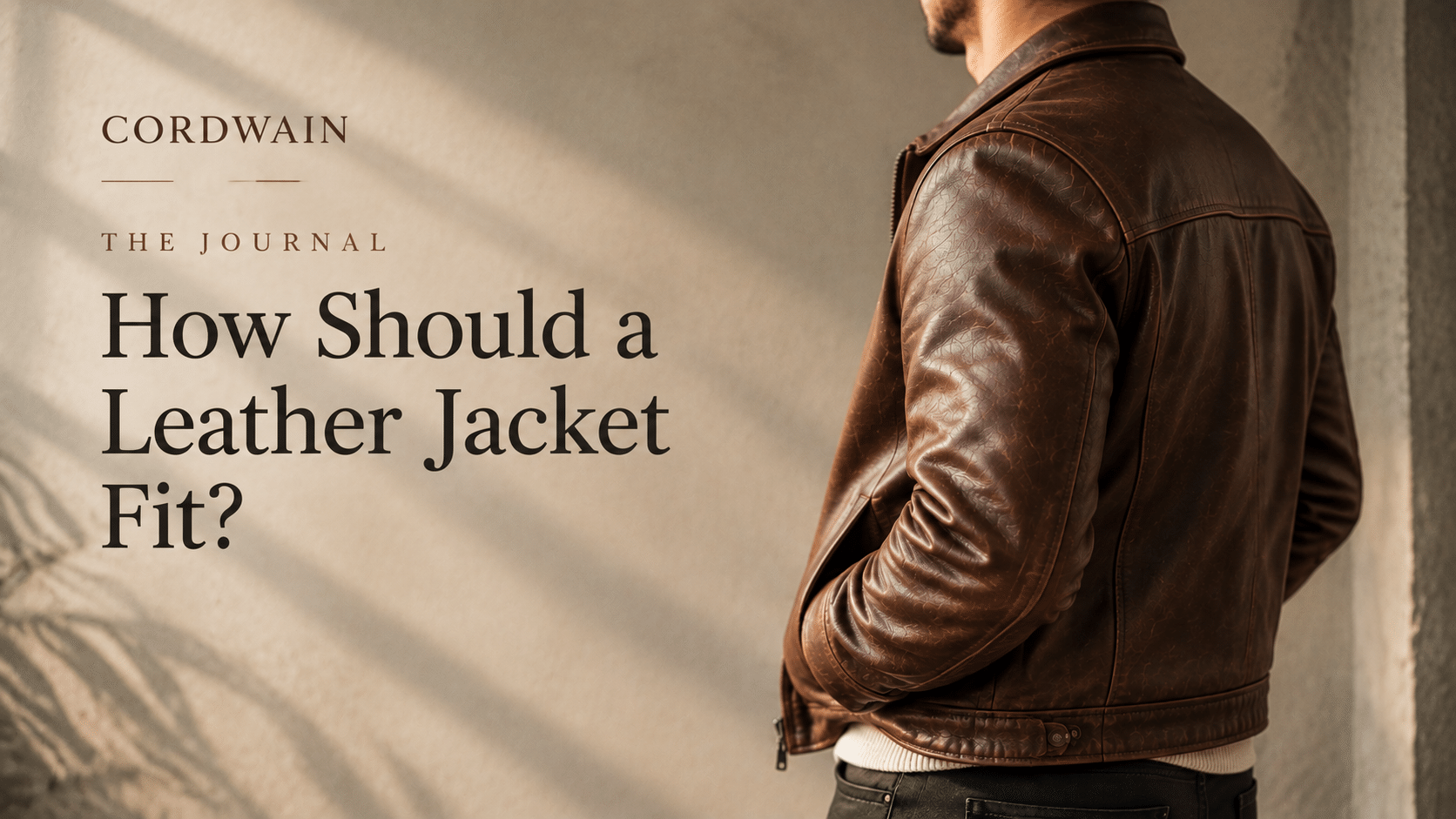
How Should a Leather Jacket Fit?
admin@Cordwain2026-10-21T13:25:29+00:00How Should a Leather Jacket Fit?
A well-fitting leather jacket looks expensive even when it is not. A badly fitting one looks cheap even when it cost a fortune. That is the whole difference, and it comes down to five places on the body — shoulders, chest, sleeves, waist and hem. This guide covers each one, with the checks that tell someone in ten seconds whether a jacket is right, what to do when sizes fall between, and how the answer changes across biker, bomber and café racer cuts.
The short answer
A leather jacket should fit close but not tight. The shoulder seam sits exactly where the shoulder ends, two fingers slide under the zipped chest, sleeves finish at the wristbone, and the hem lands at the belt or just below. Arms should cross in front of the chest without the back pulling.

Why fit matters more with leather than with anything else
Most fabrics forgive. Wool drapes over a slightly wrong shoulder, cotton gives where it needs to, and a jumper two sizes too big reads as a choice. Leather does none of that. It holds its shape, it shows every line, and it remembers how it has been worn.
That cuts both ways. A jacket bought in the right size moulds to the body over a season and ends up fitting better than anything off the rack. A jacket bought too big never recovers — leather does not shrink back, so the extra room is permanent.
The practical result: it is worth ten minutes of checking before buying, and it is worth asking someone before ordering online rather than guessing.
The five checks that decide fit
1. Shoulders — the one thing that cannot be fixed
The shoulder seam should sit exactly where the shoulder ends, at the bone. Not on the upper arm, not inside the shoulder line. This is the single most important measurement because it is the only one a tailor genuinely cannot correct — the sleeve head, the armhole and the lining all meet there.
If the seam hangs down the arm, the jacket is too big. If it digs in above the shoulder bone, it is too small. Everything else on this list can be adjusted. This one cannot, so it decides the size.

2. Chest — the two-finger rule
With the jacket zipped and nothing but a t-shirt underneath, two fingers should slide flat between the chest and the leather. One finger means it is too tight and will stay tight. A whole hand means it is too loose and will look borrowed.
Planning to wear it over a hoodie or a heavy knit? Do the check wearing that layer, not the t-shirt. Most people who layer end up one size up from their usual leather jacket size.
3. Sleeves — finish at the wristbone
Sleeves should end at the wristbone, so a shirt cuff shows perhaps a centimetre beneath. Shorter than that and the jacket looks outgrown. Longer and it swallows the hands, which is the most common way a too-large jacket gives itself away.
Sleeve length is one of the easier alterations, but only within about two centimetres and only when the cuff is plain — zips and ribbed cuffs complicate it considerably.
4. Waist — close, not compressed
A leather jacket should follow the body through the waist without pulling. Zipped up, there should be no horizontal creases fanning out from the zip — those are pull lines, and they mean the jacket is working too hard.
A little vertical creasing is normal and will settle as the leather softens. Horizontal creasing will not.
5. Hem — where the jacket stops
For a biker or café racer, the hem lands at the belt line or slightly above. For a bomber, at the top of the hip. Anything that reaches mid-seat is a coat, not a jacket, and it shortens the legs visually.
The quick test: standing straight, the hem should not cover the back pockets of the jeans.
The ten-second movement test
Fit checks are static. Real wear is not. Three movements catch what a mirror misses:
- Cross the arms in front of the chest. The back should not pull tight across the shoulder blades.
- Reach forward as if holding a steering wheel. The sleeves should not ride halfway up the forearms.
- Zip it fully and sit down. Nothing should dig in at the waist.
A jacket that passes those three will be comfortable for years. One that fails any of them will stay in the wardrobe.
Should a new leather jacket feel slightly tight?
Slightly — yes. A new full-grain jacket should feel snug and a little stiff in the first few weeks. That is the leather before it has softened, not the wrong size.
There is a clear line between the two. Snug means close everywhere but movable. Wrong means the shoulder seam is off, the chest cannot take two fingers, or the arms cannot cross. Leather relaxes; it does not resize. Roughly speaking, expect a jacket to soften and give perhaps half a size across the chest over a season of regular wear — and nothing at all across the shoulders.
How to measure for a leather jacket
Four measurements answer almost every sizing question. Use a soft tape, stand relaxed, and wear a t-shirt.
- Chest: around the fullest part, under the arms, tape level, breathing normally.
- Waist: around the natural waist, roughly at the navel, not pulled in.
- Shoulders: across the back, from the tip of one shoulder bone to the other.
- Sleeve: from the shoulder bone, down a slightly bent arm, to the wristbone.
Those four numbers, plus height and weight, are enough for anyone who knows the garment to recommend a size confidently.
How fit changes by style
Biker
Cut closest to the body, short at the hem, with the asymmetric zip. Meant to be snug — a loose biker jacket loses its shape entirely.
Bomber
Fuller through the body with ribbed cuffs and hem. The most forgiving cut and the easiest to layer under, which makes it the safest first leather jacket.
Café racer
Minimal, close, with a band collar and a straight zip. Fits like a biker through the shoulders but sits cleaner, so any excess room shows immediately.
Flight and shearling
Built to be worn over knitwear, so the chest runs generous by design. Size to the layer, not to the t-shirt.
Hooded
Usually worn over a sweatshirt, so most people take one size up. Check the chest wearing the hoodie, not without it.

Fit by build
Slim
Café racer and biker cuts suit narrow frames because they follow the body. Avoid anything with a full chest — it reads as borrowed.
Athletic
Broad shoulders and a narrower waist make shoulder fit the deciding factor. Size to the shoulders and have the waist taken in if needed.
Broad or stocky
A bomber cut sits better than a close biker. Look for a hem that ends at the hip rather than above it.
Tall
Sleeve and body length matter more than width. A jacket that fits the chest but stops short at the wrist will always look wrong.
What to do when sizes fall between
Size up if the jacket will be worn over a hoodie or knit, if the shoulders feel tight in the smaller size, or if the arms cannot cross comfortably.
Size down if the smaller size fits the shoulders and only the waist is slightly close — leather gives there. And if the shoulder seam hangs past the shoulder in the larger size, the decision is already made.
Where a brand offers made-to-measure, between-sizes is exactly the case it solves.
What a tailor can and cannot change
- Can be altered: sleeve length within about two centimetres, waist taken in, body shortened slightly.
- Difficult and expensive: sleeve width, hem with ribbing or zips.
- Cannot be fixed: shoulders.
Leather alterations also leave permanent needle holes, so a tailor gets one attempt. Buying the right size is cheaper than correcting the wrong one.
Not sure which size to take?
Send a height, weight and usual size, and a real person replies with an honest recommendation — before anything is ordered.
Frequently asked questions
Should a leather jacket fit tight or loose?
Close, not tight. Two fingers should slide between the zipped chest and the body over a t-shirt. Tight leather does not stretch into comfort, and loose leather never tightens up.
Is it better to size up or down in a leather jacket?
Size up when layering over a hoodie or knit, or when the shoulders feel tight. Size down when only the waist is close — leather gives there, but never across the shoulders.
How do I know what size leather jacket I need?
Measure the chest, waist, shoulders and sleeve, then compare against the garment measurements rather than a generic size chart. Height and weight help someone experienced narrow it further.
Does leather stretch over time?
Full-grain leather softens and gives a little across the chest and elbows with regular wear — roughly half a size over a season. It does not stretch across the shoulders, and it never shrinks back.
Should a leather jacket crease when zipped?
Vertical creasing is normal and settles as the leather softens. Horizontal creases fanning out from the zip mean the jacket is too tight through the chest or waist.
How do I know if the shoulders are too small?
The seam digs in above the shoulder bone, the armholes feel restrictive, and crossing the arms pulls the back tight. If any of those happen, the size is wrong regardless of how the chest feels.
What should someone wear when trying on a leather jacket?
Whatever will usually be worn underneath. A jacket checked over a t-shirt but worn over a hoodie all winter will feel a size too small every time it matters.
Can a leather jacket be tailored?
Sleeves, waist and body length, yes. Shoulders, effectively no. Leather also holds needle holes permanently, so alterations are a one-shot job.

Leave a Reply