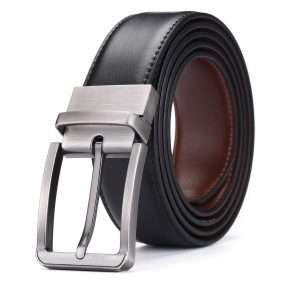
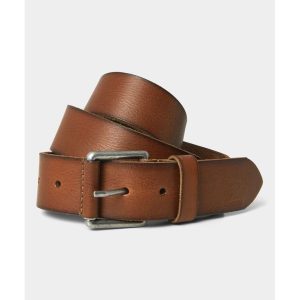
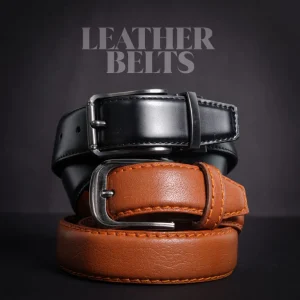
Full-grain leather belts cut from a single strap of hide rather than two bonded layers, with solid hardware. Size from the waist of pants you already wear, plus two inches. Free worldwide shipping with duties paid.
A belt is the cheapest thing in your wardrobe that people look at every day, and the easiest to buy badly. Almost every belt under thirty dollars is two thin layers glued together with a coating sprayed on top, and it splits down the middle within a year. What follows is how to tell the difference, and how to get the size right the first time.
What size belt do you actually need?
Take the waist measurement of pants you already wear and add two inches. That number is your belt size, and it is almost never the same as the number printed on your jeans, which is a cut size rather than a measurement. The other way to check is to measure an existing belt you like from the buckle's fold to the hole you use — that length is your size. If you sit between two, or wear the belt over different layers, message us before ordering.
How do you spot a bonded belt without cutting it?
Look at the cut end and the edge. A single-strap belt shows one continuous cross-section, slightly fibrous, the same color all the way through. A bonded belt shows a sandwich — a colored skin, a pale pulpy core, sometimes a fabric layer. Then bend it hard into a U. A solid strap creases and springs back; a bonded one shows fine cracks along the outside of the bend, and those cracks are where it will eventually fail.
Which width goes with what?
Measure your pants' belt loops before anything else, because a belt that will not pass through them is useless. Around 1.25 inches is the dress width and sits correctly with tailored pants and a suit. Around 1.5 inches is the everyday width for jeans and chinos, and it looks proportionally right with heavier fabric. Wider than that reads as workwear, which is a fine thing to want on purpose.
Why does a belt outlast almost everything else in leather?
Because the load on it is steady and in one direction. A jacket flexes at the elbow thousands of times and a wallet folds double every day, but a belt is held under even tension and rarely bent. That is why belt leather is cut thick and firm rather than soft, and why a good one lasts a decade or more while the holes you use slowly stretch into ovals.
Choosing a width
Width
Goes with
Reads as
Buckle
1.25 in
Suits, tailored pants
Formal
Slim, flat
1.5 in
Jeans, chinos
Everyday
Standard harness
1.75 in
Workwear, heavy denim
Rugged
Heavy, wide
Specification
Price
$ 69
Leather
Full-grain cowhide, single strap
Sizing
Pants waist plus two inches
Shipping
Free worldwide, duties paid
Questions, answered
How do I measure for a belt?
Measure a belt you already wear from the fold at the buckle to the hole you actually use. That length in inches is your size. Failing that, take your pants waist measurement and add two.
Is the belt one piece of leather or layers?
One strap, cut from a single hide. Layered belts are glued, and glue is what fails — the two halves separate along the length and the belt starts to curl.
Will the buckle wear out?
Solid metal buckles outlast the strap. Plated ones wear through to a different colored base metal at the tongue and the fold, usually within two years of daily use.
Can I shorten it myself?
Yes. Remove the buckle at the fastening, cut from the buckle end, punch a new hole for the fastening and reattach. Cutting from the tip end instead leaves you with a stub too short to sit in the keeper.
Should the belt match my shoes?
Same family rather than an exact match — brown with brown, black with black. Chasing an exact shade is a lost cause, because leather from different hides ages at different rates anyway.
Why do the holes stretch?
Because the tension concentrates there. On full-grain the hole ovals slightly and stops; on bonded leather it tears through, which is the usual way a cheap belt ends.
For wallets and small leather goods that age the same way, see the wallets and accessories pages. If you are putting an outfit together, the men's jackets hub is the place to start.