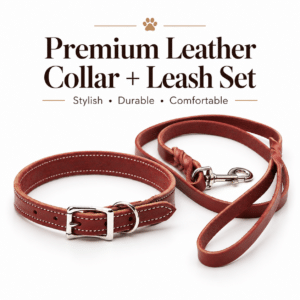
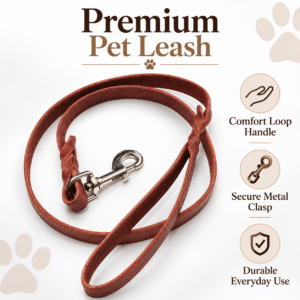
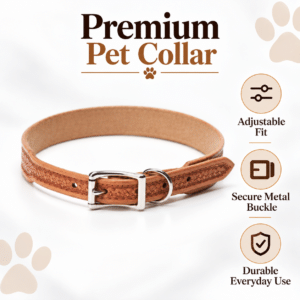
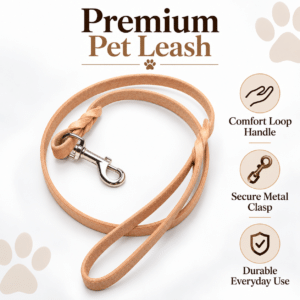
Leather dog collars and leashes outlast nylon for one reason that has nothing to do with strength: nylon stays exactly as abrasive as the day you bought it, while leather softens to the neck it sits on. Every full grain dog collar and leash here uses solid nickel hardware. Below is how to size a collar, how to choose a leash length, and the one check worth doing before you buy anything from anyone.
Dog collar size guide: how to measure
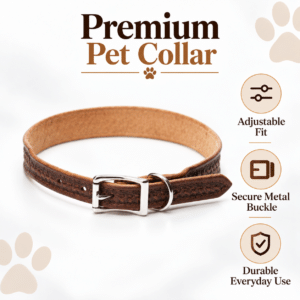
Run a soft tape around the neck just below the ears, where the collar will actually sit, snug without compressing the coat. Then check two fingers slide flat underneath. That measurement is the size you order, and the leather dog collar sizes below run from an 18 in to a 24 in neck \u2014 a collar is sized by the neck it fits, not by the overall length of the strap, which is always longer. Measure the dog in front of you rather than trusting a breed chart; two Labradors can be three inches apart.
Nylon vs leather dog collar — which lasts?
Nylon is woven, which means it stays abrasive forever and holds water against the skin. Under a collar worn sixteen hours a day that is what wears a line in the coat. Full-grain softens within weeks and takes the shape of the neck, so the pressure spreads instead of concentrating at an edge. Nylon dries faster and costs less, and for a dog that swims daily that may still be the right trade \u2014 but it will never get more comfortable than it was new.
What length of leash do you want?
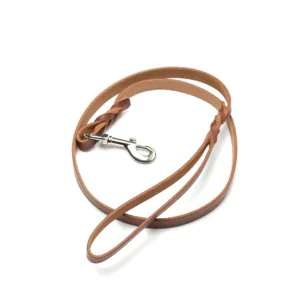
Four feet keeps a dog at your side and is the length for traffic, crowded pavements and a dog still learning not to pull. Six feet gives enough slack to sniff without you being towed, and is the everyday default for most people. Anything longer is a training line rather than a walking leash, and it tangles around legs \u2014 yours and other people's \u2014 in any public space.
Collar or harness \u2014 which should you buy?
A collar is for identification, a tag and ordinary walking. A harness is for a dog that pulls hard enough to put its own weight through its throat. The honest line is that no flat collar, in any material at any price, is the right answer for a dog that lunges \u2014 that is a harness and a trainer, not a buying decision. If your dog walks on a loose leash, a collar is more comfortable and far less fuss.
The one check worth doing before you buy any collar
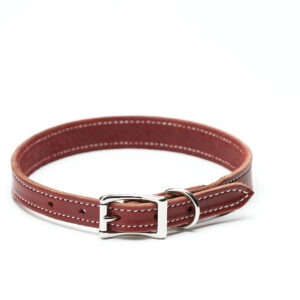
Look at the D-ring. If it is bent wire with a visible gap where the ends meet, that gap is where it opens under a hard sideways pull. A welded ring has no gap. It costs a few cents more to make and it is the single most common failure on a collar that was otherwise fine. Every ring here is welded closed.
Keeping leather on a dog that gets wet
Rain, puddles and the occasional swim are fine. What damages a hide is heat, so dry it at room temperature and never on a radiator or in front of a fire \u2014 forced drying is what cracks leather, not the water. Let mud dry completely and brush it off rather than wiping it wet, which drives it into the grain. Condition two or three times a year at most; an over-conditioned collar collects more dirt than a dry one.
S 18 in \u00b7 M 20 in \u00b7 L 22 in \u00b7 XL 24 in neck
Colours
Dark brown, light brown, natural tan
Shipping
Free worldwide, duties paid
Returns
Yes — 30 days, unused and with tags attached.
Questions, answered
What size collar does my dog need?
Measure the neck just below the ears and allow two fingers underneath. Small fits an 18 in neck, Medium 20 in, Large 22 in and XL 24 in, and each size adjusts a little either way. Between two sizes, take the larger.
Are these leather dog collars safe if my dog swims?
Yes. Rinse off salt or chlorine, then dry at room temperature away from any heat source. Repeated soaking will dull the finish over time but will not weaken a single strap of full-grain.
Will a collar hold a dog that pulls?
For ordinary walking, yes. For a dog that lunges hard enough to pull you off balance, no flat collar is the right equipment \u2014 that needs a properly fitted harness and a trainer. These are everyday collars, not restraint or training devices.
What leash length should I choose?
Four feet for traffic and crowds, six feet for everyday walking with enough slack to sniff. Longer than six feet is a training line and tangles in public.
Is the hardware solid or plated?
Solid nickel. Plated hardware wears through at the buckle tongue and the swivel first, and what shows underneath is base metal that corrodes.
How do I clean a muddy collar?
Let the mud dry completely, then brush it off. Wiping wet mud drives it into the grain, especially on the natural tan.
Can I return it if the size is wrong?
Yes — 30 days, unused and with tags attached. Send us the neck measurement before ordering and you will get one size back rather than a chart, which avoids the return entirely.
The collars and leashes here are cut from the same hides as the leather belts, and age the same way. For small leather goods in matching tones, see the wallets and accessories pages.