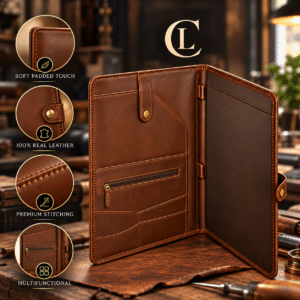
Brown is the colour you buy if you want the folder to look better in five years than it does in the box. Full-grain brown darkens where it is handled and lightens where it is rubbed, and the pattern that produces is specific to how you carry it — which is also why brown is unforgiving of leather that is not full-grain, because a coated surface cannot do any of it and just stays the same until it cracks.
Which brown? Tan, cognac, chocolate or distressed
They are four different decisions, not four shades of one. Tan is the lightest and ages the most dramatically, going several tones darker in the first year, and it marks the most easily in the meantime. Cognac is mid-brown with red in it, the most versatile of the four, and the one that looks deliberate against both navy and grey. Chocolate is dark enough to pass in a formal room where tan would not, and changes the least visibly. Distressed is finished to look worn from the start, which means it hides new marks well and will never look noticeably different from the day you got it.
Is a vintage leather portfolio finish worth choosing?
It depends entirely on why you wanted brown. A vintage leather portfolio — distressed, antiqued, pull-up — is finished to look aged before it leaves the workshop, which is excellent at hiding the first few years of marks. The cost is that it will never look meaningfully different from the day it arrived. If the ageing is the reason you chose brown at all, choose tan or cognac instead and let it happen on its own. Every real leather portfolio here is full-grain cowhide, aniline dyed, 10 by 13 inches closed.
What patina actually is, and what it is not
It is the surface of the hide changing under oil from your hands, friction, and light. Full-grain still has its pores and its fibre structure open at the surface, so all three reach the leather and the colour deepens unevenly — darker at the spine and the corners you hold, lighter across the face. It is not dirt, and it is not damage. What it is not available on is coated leather, because the coating is a layer of finish sitting over the hide and nothing gets past it. A folder that looks identical after two years of daily use was never full-grain.
The shoes-and-belt rule, and when to ignore it
The conventional rule is that leather accessories should share a family with your shoes and belt, and for belts and shoes it is worth following because they sit in the same sightline. A folder is different: it spends most of its life on a table, away from your feet, and nobody has ever tracked a folder against a shoe. Stay in the same broad family — brown with brown — and stop there. Chasing an exact match is a losing game anyway, because two brown hides from different batches age at different rates and will diverge within a year whatever you do.
Where brown works, and where it reads wrong
Brown works in creative, technical, academic, sales and most corporate settings, and in those rooms it reads as considered rather than as a choice someone will question. It reads wrong in three places: formal legal and financial settings where black is effectively the uniform, anywhere you are wearing black shoes and a black belt, and on a stage or on camera where a warm tone pulls focus. If most of your weeks include one of those, buy black and keep brown for the other days.
Keeping a brown folder from going blotchy
Brown shows water in a way black does not, and the mistake is treating a mark as a stain to be scrubbed. A water spot is a ring where the surface oils moved, and the fix is to let the whole panel take a light even dampness with a cloth and then dry flat at room temperature, so the tone evens out rather than leaving an edge. Never dry it near a radiator — forced drying is what cracks a hide, not the water. Condition two or three times a year and keep it out of direct sun, which lightens brown far faster than use darkens it.
The four browns
Shade
Tone
How much it changes
Reads as
Tan
Light, honey
A great deal, fast
Casual, warm
Cognac
Mid, red undertone
Noticeably, evenly
Considered, versatile
Chocolate
Dark, neutral
Slowly, subtly
Near-formal
Distressed
Varies, pre-aged
Very little
Rugged, forgiving
Brown or black — deciding
Brown
Black
Formal legal or finance
Risky
Correct
Creative, tech, academic
Correct
Fine but flat
With brown shoes and belt
Correct
Avoid
Looks better over 5 years
Yes
Holds, does not improve
Hides marks day to day
Shows water
Shows dust
Specification
Price
$ 120
Leather
Full-grain cowhide, aniline dyed
Shades
Tan, cognac, chocolate or distressed, by product
Edges
Folded and stitched, not cut and painted
Exterior
10 × 13 in (25.4 × 33 cm) closed
Pad bay
A4, and US letter also fits
Closure
Snap tab
Interior
A snap-flap document pocket, an angled easy-access slip pocket, a zip pocket, four business card slots and two pen holders, with an A4 notepad sleeve on the right
Hardware
Brass-tone zip pull and snap stud
Shipping
Free worldwide, duties paid
Returns
30 days, unused and with tags attached
Questions, answered
Will the brown darken over time?
Yes, and unevenly, which is the point. Oil from your hands and friction at the spine and corners deepen those areas first, while the flat face stays lighter. Tan changes most and chocolate least. A folder that looks identical after two years was not full-grain.
Is the colour exactly what the photo shows?
Close, not exact. Aniline dye goes into the hide rather than sitting on it as a pigment layer, so the hide's own density varies the final tone slightly from piece to piece. Two folders in the same shade will not be identical, and neither will stay the shade they started at.
Does brown look unprofessional?
Not in most settings. It is the wrong call in formal legal and financial rooms where black is effectively the uniform, and it clashes if you wear black shoes and a black belt. Everywhere else it reads as considered.
How do I get a water mark out of brown leather?
Do not scrub it. Damp the whole panel lightly and evenly with a cloth, then dry it flat at room temperature away from any heat. That levels the tone instead of leaving a ring. Heat is what cracks leather, not water.
Which brown goes with navy?
Cognac, and it is the easiest pairing in the range. Tan against navy reads casual and chocolate against navy can go muddy in low light.
Do I need to condition it?
Two or three times a year is plenty, and a cover that is over-conditioned goes soft and stops lying flat. Keeping it out of direct sunlight matters more than any product does.
How long is delivery, and are duties included?
Typically 4 to 9 working days, worldwide. Import duties and taxes are settled before dispatch where the carrier supports Delivered Duty Paid to your country, and the terms for your country are confirmed at checkout.
Black is the one for formal rooms where brown would be a choice someone notices. Mocha brown crunch is brown with a milled surface that hides marks. The belts page uses the same hides and ages the same way.