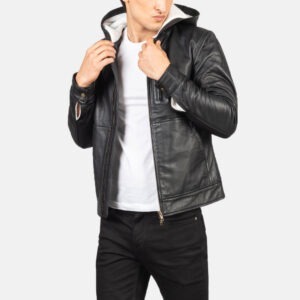
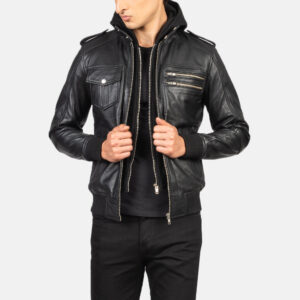
Black leather jacket with a leather hood lined in off-white jersey, a vertical zip chest pocket, slash hand pockets and a straight hem rather than a rib.
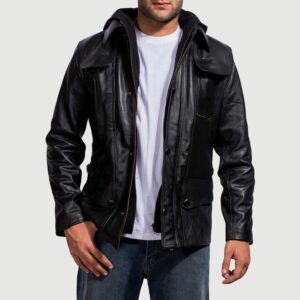
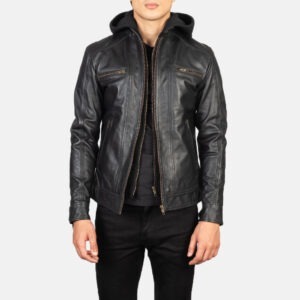
Longer black leather field jacket with a hood under a pointed collar, a button placket over the centre zip, two flap chest pockets, two flap hip pockets and a zip…
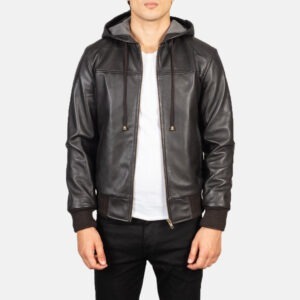
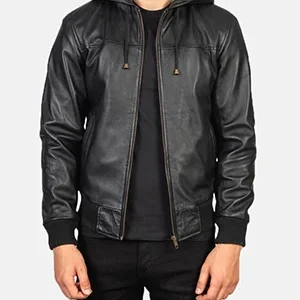
Black hooded leather bomber with epaulettes, a snap flap pocket on one side of the chest and twin zips on the other, and knitted rib at the cuffs and hem.
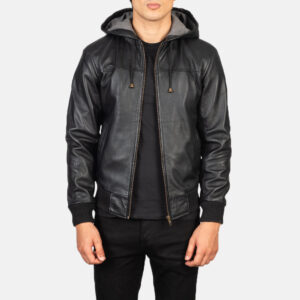
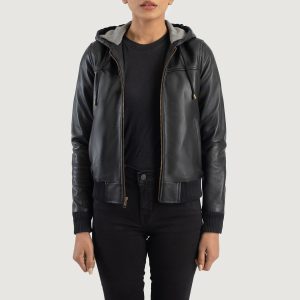
Black leather bomber with a built-in hood — leather outside, soft grey jersey inside — drawcords, centre zip, zip hand pockets and ribbed cuffs and hem.
A hood is the detail that turns a leather jacket from something you plan an outfit around into something you grab on the way out. It also settles the argument leather has always lost against a rain shower. What almost nobody selling these explains is the part that decides whether you keep wearing it: whether the hood comes off, how it sits over a sweatshirt, and what it does to the size you should order. That is what this page is for.
Should the hood be removable or fixed?
Removable, for almost everyone buying one jacket. It zips or snaps off, so the same piece is a hooded winter jacket in December and a clean bomber or biker in April — two jackets for one price, and the reason removable hoods dominate this category. A fixed hood lies flatter across the back when down and looks tidier, which is a real advantage if you already own other leather and want this one to be specifically a hooded jacket. The mistake is buying fixed by accident. Check the product page before you order, because it is not something you can change later.
How does the hood sit over a sweatshirt?
This is where most hooded leather jackets fail, and it comes down to the neck opening. If the collar is cut high and narrow, a sweatshirt hood underneath bunches into a lump that pushes the jacket collar up your neck and holds it there. A jacket cut for layering has a wider, lower neckline, so a hoodie sits under it flat and the two hoods stack instead of fighting. If you wear a hoodie most days, that measurement matters more than the leather does. It is worth checking on anything you compare this against — pull the collar open and see whether there is room.
What size should you order?
Your usual size in a leather jacket. Hooded jackets are cut with room through the chest and shoulders already, because the pattern assumes a sweatshirt underneath. The common error is sizing up on top of that, which drops the shoulder seam down your arm — and a dropped shoulder seam is the one fault that no alteration can repair. Only go up if you layer something thicker than a hoodie. Send us your chest measurement, height and usual jacket size and we will give you one answer rather than a chart.
Which base style should the hood be on?
A hood changes every silhouette it lands on. On a bomber it is the most natural fit, because the ribbed hem and relaxed body already read casual and the hood simply completes it — this is the combination most people mean when they search for a hooded leather jacket. On a biker the hood softens the asymmetric zip and wide lapels into something you can wear on a normal Tuesday, though the lapels and hood compete slightly at the neck. On a café racer the hood is the most unexpected and the sharpest, because the band collar leaves room for it. On a puffer it is a genuine winter feature rather than a style choice.
Does the leather weight change how the hood hangs?
Yes, more than people expect. Jacket leather generally runs between roughly 0.8mm and 1.2mm. At the lighter end the hood drapes and folds softly against your back when it is down. At the heavier end it holds its shape and stands slightly away from the shoulders, which some people like and others find bulky. Heavier hide is more durable and takes longer to break in; lighter hide is more comfortable from day one. Neither is better — but a heavy hood on a jacket you wear open, hood down, will always sit proud.
Is leather actually sensible in the rain?
For a shower, yes, and the hood is the whole point of asking. Full-grain sheds light rain and you wipe it dry. In sustained heavy rain it will eventually wet through, and what happens next is what matters: it must dry slowly, at room temperature, away from radiators, heaters and hairdryers. Forced heat is what ruins wet leather, not the water itself — it drives the oils out of the hide and the grain stiffens and cracks. Hang it on a wide hanger, leave it overnight, and condition it once it is fully dry.
How do you store a hooded jacket without wrecking the hood?
On a broad-shouldered hanger with the hood laid flat down the back, never folded up inside the collar. A hood crushed into a collar for a whole summer sets a crease along the fold that does not come out. If the hood is removable, take it off in spring and store it flat. And keep the jacket out of a plastic garment bag — leather has to breathe, and sealed plastic traps moisture against the hide and grows mildew on the lining.
Black or brown?
Black is the safer first hooded jacket. The hood already pushes the jacket towards casual, and black keeps it from tipping all the way into sportswear — it still works over a shirt. Brown reads warmer and more relaxed, which suits the hood well but narrows what it goes with: brown leather sits badly next to black jeans and black boots, and that rules out a large part of most wardrobes. Buy black first and brown second, unless your wardrobe already leans to denim, olive and cream.
Removable against fixed hoods
Removable hood
Fixed hood
Jackets you get
Two — hooded, and plain
One
Sits when down
Slight bulk at the collar
Flat against the back
Summer storage
Detach and store flat
Stays on the jacket
Best for
Your only leather jacket
A second or third jacket
A hood on each silhouette
Base style
Reads as
Room to layer
Best months
Bomber
The natural pairing
Hoodie, easily
All year
Biker
Softened, less formal
A hoodie, snugly
Fall and spring
Café racer
Sharpest, least expected
A fine knit
Fall and spring
Puffer
Genuine winter gear
Shirt and knit
Deep winter
Specification
Price
$ 280 – $ 319
Leather
Full-grain cowhide
Sizes
S – 4XL
Shipping
Free worldwide, duties paid
Questions, answered
Do I need to size up for a hoodie underneath?
No. The room for a sweatshirt is already built into the cut. Size up only for something heavier than a hoodie, and tell us first so we can check rather than guess.
Will a hooded leather jacket still look smart?
Less than a café racer or a blazer, by design — a hood makes a jacket casual, and that is what you are buying it for. If you need leather that works with a collared shirt and trousers, that is a different jacket.
Can I wear it in the rain?
Light rain, yes. Wipe it down afterwards and let it dry at room temperature, away from any heat source. In heavy rain it will eventually soak through, and slow natural drying is what protects it.
Is this real leather or faux?
Full-grain cowhide, the top grade of real hide. Several jackets sold in this category are faux suede or bonded leather — the word 'genuine' on a label is not a guarantee of it, because 'genuine leather' is itself one of the lower grades.
How long does it take to break in?
Two to four weeks of regular wear. Full-grain starts firm because nothing has been sanded off the surface, and it softens from the inside as your movement works the fibers. Never speed it up with heat or oil.
If you like the relaxed fit but do not want a hood, the bomber is the closest thing. For genuine winter warmth with a hood, look at the puffer.